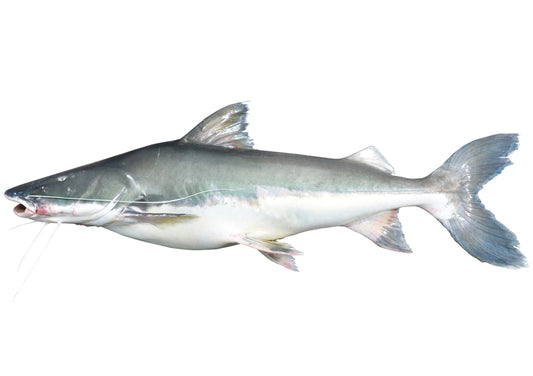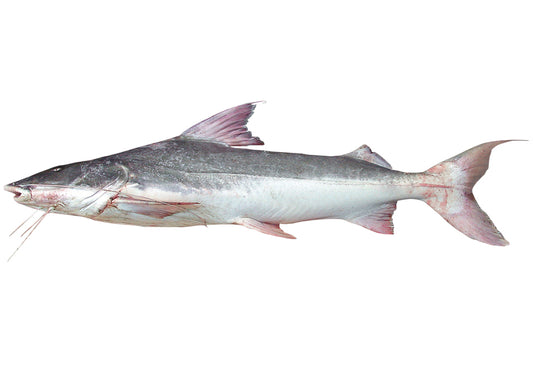

Green Weakfish - Cynoscion virescens
Now you'll have no more doubts when choosing the right weakfish! We present another article in the "Unveiling Weakfish" series, with Chef Pedro Bichir and oceanographer Cintia Miyaji. Today, the spotlight is on the green weakfish, one of the most valued and appreciated weakfish by chefs.
The Green Weakfish
As valued as the yellow weakfish, the green weakfish is considered one of the best options among weakfish. It can reach up to 75 cm in length, has a more rounded body, and a darker back – a distinguishing feature compared to the yellow weakfish.
Key Features
✔ Average size: 3 to 4 kg, intermediate between white weakfish and yellow weakfish.
✔ Body shape: More rounded.
✔ Coloration: Dark back, contrasting with white weakfish and without the yellowish tones of yellow weakfish.
Chef Pedro Bichir, a fish specialist and FishCode expert, describes the green weakfish as "the Ferrari of weakfish." With white, firm, and perfectly textured flesh, its flavor is mild, making it an exceptional choice for various preparations.
Differences Between Weakfish: Green, White, and Yellow
|
Characteristic |
Green Weakfish |
White Weakfish |
Yellow Weakfish |
|
Average Size |
3 to 4 kg |
2 kg |
+10 kg |
|
Body Shape |
More rounded |
Elongated |
Elongated |
|
Coloration |
Dark back |
Light |
Yellowish tones |
|
Flesh Texture |
Firm, ideal for precise cuts |
Very delicate, requires careful handling |
Slightly firm, great for roasting and grilling |
The green weakfish stands out for the firmness of its flesh, making it an excellent choice for raw preparations such as ceviches and sashimis. The white weakfish, on the other hand, has more delicate and fragile flesh, requiring more attention when handled. The yellow weakfish, in turn, has golden tones and a larger size, and is widely used in roasts and grilling.
Preparation Tip: Green Weakfish in Ceviche or Sashimi
Due to its firmness and refined flavor, the green weakfish is ideal for raw preparations. Its texture allows for precise cuts, ensuring a sophisticated and balanced dish.
📌 Check out Chef Pedro Bichir's special recipe and discover how to transform this delicacy into a unique gastronomic experience!
Sustainability: Conscious Choice
Green weakfish is a highly appreciated species, and sustainable fishing is essential for its preservation. Always choose suppliers who practice responsible fishing, respecting the fish's natural cycles and ensuring the conservation of marine stocks.
By choosing weakfish consciously, you contribute to the preservation of the oceans and guarantee the quality of the fish that reaches your table!
Scientific name: Cynoscion virescens (Cuvier, 1830)
FAO English name: Green weakfish
FAO Spanish name: Corvinata cambucú
Common name for inspected products: Pescada, Pescada-Cambucu, Pescada-Cambuçu, Pescada-Cambuci, Pescada-Corvina
Other common names: Bacalhau, Camacu, Corumbeba, Pescada-do-Alto, Pescada-do-Reino, Pescada-Real, Rabo-Seco, Corvina-Cobra, Pescadilla.
The Green Weakfish occurs at depths of up to 70 meters in the Atlantic Ocean, from Panama to Argentina, being more difficult to find at the southern limits of its distribution. It occurs in estuarine regions with sand and mud bottoms. Adults remain in deep locations near the bottom during the day and migrate near the surface at night, in small or large schools.
It feeds mainly on shrimp and small fish.
It is a large weakfish, reaching up to 95 cm in length and 4 kg, but generally has a commercial size between 45 and 65 cm. Its longer and lower shape compared to other weakfish is one of its striking characteristics. Its coloration is silvery, darker on the back and whitish on the belly.
The first portion of the dorsal fin has a blackened margin, and the second portion may have small dark spots on the rays. The caudal fin is rhomboid, meaning it ends in a diamond shape, and is blackened. The other fins may be clear, yellowish, or orange.
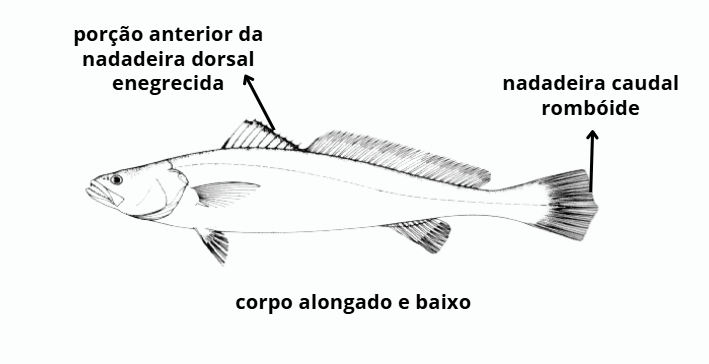
Cynoscion virescens with highlighted distinctive characteristics. Adapted from https://www.fao.org/4/t0544s/t0544s00.htm
The Green Weakfish is assessed on the IUCN Red List (International Union for Conservation of Nature) as Least Concern (LC).
Its swim bladder is used as raw material for the production of isinglass or ichthyocolla, a collagen-like substance with various applications, such as clarifying alcoholic beverages or as glue.
Now that you know more about green weakfish, how about trying an incredible recipe with it?