
The extra shipping cost and the true quality of fresh salmon!
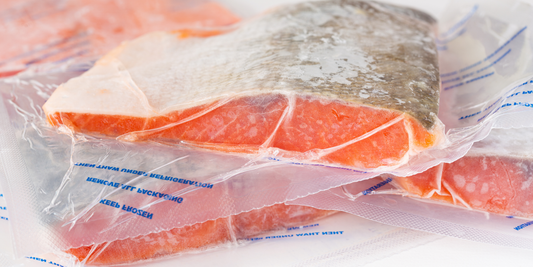
There's a big myth surrounding frozen fish and shrimp. As a rule, frozen fish means old product. Unfortunately, some retail practices (freezing to prevent spoilage) do lead to this understanding. However, when freezing is applied correctly, and especially at the right time (while the fish is still fresh), it is the best way to preserve meat products. Period.
But what about the formation of microcrystals inside the cell that, upon thawing, can perforate the cell membrane, leading to fluid loss (exudation)? Is that true? Yes, it's true! To a greater or lesser extent, this happens. However, there are strategies (ultra-freezing) to mitigate this, and even if exudation occurs on a larger scale, any damage to meat quality is less than the damage involving chemical-enzymatic reactions and bacterial proliferation, which, undeniably, occur at positive temperatures. Negative temperatures, on the other hand, cease these reactions.
How is salmon shipped to Brazil?
Brazil imports both frozen and fresh salmon. While 100% of wild salmon arrives on the Brazilian market frozen, around 90% of farmed salmon arrives as fresh on ice. A small quantity of farmed salmon, of the species known as Coho, comes frozen to meet retail demands. The largest volume, by far, is of fresh farmed salmon on ice.
Just as there's a myth that frozen fish is old fish, there's also a myth that you shouldn't freeze "fresh" salmon or that frozen salmon loses quality. Is that really true? From a technical and practical point of view, does this make sense, or is it more of a consumer opinion?
Follow me through some surveys I conducted with large salmon importers here in Brazil, as well as some technical issues involved in "fresh on ice" transportation related to salmon.
- Some consumers prefer wild salmon, which, by the way, is priced higher than fresh/farmed salmon. There are no reports questioning the quality of this product due to it being frozen. On the contrary, it is considered a premium salmon.
- Brazil is the third largest buyer of Chilean salmon, behind Japan (2nd) and the USA (1st). In the case of Japan, it's unnecessary to comment on how demanding this market is; 100% of Chilean salmon is shipped frozen!
- The truth about land transport of farmed salmon from Chile to Brazil:
Regarding item 3, the discussion is extensive, but every detail of this complex and extremely well-studied process, which is the cold chain involving the transport of salmon from Chile to Brazil, is worth it.
Here we go. The salmon is dispatched practically on the same day it is harvested, slaughtered, and processed. The fish is chilled to 0°C and packed in styrofoam boxes containing an average of 24 kg of salmon and 8 kg of ice (32 kg per box). Note that 25% of the total volume is ice.

Figure 1. Styrofoam box containing, on average, 24 kg of salmon and 8 kg of ice.
The styrofoam boxes are then transferred to the truck. The refrigeration system of the trucks is programmed, as a rule, to maintain the temperature between -12°C and -14°C. Obviously, this temperature does not reach the fish, as it is inside the styrofoam box. The land transport from Chile to Brazil takes between 8 to 10 days (varies according to weather conditions).
The internal temperature of these boxes is stratified/divided into 4 levels, according to the box's position in the truck, with:
- Boxes stowed at the top of the truck travel at temperatures ranging from -1°C to -3°C. Technically, according to Brazilian legislation, this product is classified as "fresh crystallized." Despite being at a negative temperature, it cannot be classified as frozen.
- Boxes in the middle of the load maintain a temperature ranging from 0°C to 3°C. Undeniably fresh!
- Boxes on the floor have two distinct temperature ranges:
C1) Those boxes located over the truck's wheels (tires) fluctuate in temperature between 1 and 5°C.
C2) The other boxes on the floor, temperatures between 1 and 3°C.

Figure 2. Truck with a capacity of 24 tons and the wheel area highlighted.
In summary, one part travels at negative temperatures and another part at positive temperatures. It is worth noting that negative temperatures practically cease chemical-enzymatic reactions at the cellular level and bacterial proliferation. Positive temperatures imply some level of these reactions, and the further from zero, the faster they are.
The boxes that travel over the truck's wheels arrive with melted ice. This significantly compromises the product's quality. The proper treatment is to open all these boxes, drain the water, and add new ice.
If you could choose, which would you choose, fresh or frozen salmon?
Salmon that traveled for 10 days on top of the truck at -3°C or the one that traveled over the wheels at +5°C? If you consume salmon frequently and value maximum quality, you've probably tasted both. Is it possible to practically identify which one traveled as fresh crystallized and which one traveled fresh? It's worth noting that transportation is only one step in the cold chain, as fish preservation strategies in establishments are just as important.
Another important aspect is the shelf life. It's 21 days from the departure date from Chile. Of these, 10 days are spent on the road. Will a salmon kept at positive temperatures on its twenty-first day have the same quality as the day it arrived? Restaurants that offer exquisite salmon dishes cannot run out of this delicacy. But when a new order arrives and there's still salmon in stock, which one will be served first?
Frozen fish, the truly fresh fish!
Especially when the correct technology is applied, in this case, ultra-freezing, and at the right time, that is, while the product is still at its peak freshness. And if all salmon were frozen and traveled at negative temperatures (in this case, -18°C), would there be a difference for consumers' palates? If so, for better or worse? From a logistical, food safety, and cost perspective, there's no doubt it would be better.
Returning to the example of Japan, which receives 100% frozen Chilean salmon, I consulted Chef Sushiman Fernando Koike, from Montoza Pescados, who has worked as a Sushiman in Japan. "_ Frozen salmon is normally used for both sashimi and sushi. Initially, there was some resistance to salmon itself, today they are consuming it more and more."
It is thus concluded that this is a matter of market demands imposed by consumers and not by the industry. Therefore, it depends on a change in attitude from those who buy/consume, not from those who sell.
How much do we pay for the ice that comes from Chile?
Appreciating quality salmon is priceless! Is it? First, there is no practical evidence related to better quality due to salmon not being frozen. When it comes to 21 days of preservation, no. There would indeed be differences comparing freshly harvested fresh salmon with frozen salmon! But, considering that the first case is not reality, we have to look at the scenario as a whole. Second, in this particular case, the embedded freight cost of the ice we bring from Chile can indeed make a considerable difference in the final product price.
Let's crunch the numbers:
_ Average truck freight price for 24 tons gross weight: U$ 8,000;
_ Average dollar exchange rate Jan. to Oct. 2024: R$ 5.52;
_ Freight value in Reais: U$ 8,000 x R$ 5.52 = R$ 44,174.00 (R$ 1,840.00 per ton);
_ With 25% being ice: R$ 44,174.00 X 25% = R$ 11,043.50 is the value we pay for the ice that comes from Chile per truck!
According to information from the Chilean National Customs Service, in the first seven months of 2024, Chile sent 86,074 tons of salmon to Brazil. This amount needed to be accompanied by ice, which, in this case, represents 25% of this quantity. So we have 21,518 tons of ice. Multiplying this amount of ice by the freight value, R$ 1,840.00/T., will yield R$ 39,593,000. That's right, almost 40 million Reais is the amount spent on ice in the first seven months of 2024.
Salmon that smells like watermelon?
To conclude, a precious and at the same time extremely curious tip. Something I had only read about in literature but had never witnessed. When visiting a large importer and inspecting a newly arrived shipment, I had the opportunity to witness that truly fresh salmon smells like watermelon. But it's not the flesh itself that smells like watermelon, but rather the inside of the belly. So, when you have the opportunity to encounter a whole salmon, try smelling the inside of its belly. If it has a strong fishy smell, avoid it! To be truly fresh, it must smell like watermelon!