
Article Cintia Miyaji & Paiche
Eating shark: yes or no?
Eating shark: yes or no?
For a long time, the consumption of shark meat has been questioned by environmentalists worldwide. In recent years, the urgency of climate issues has brought many environmental and sustainability agendas, previously restricted to specific audiences, into discussion with the general public. Furthermore, discussions about actions for the United Nations Decade of Ocean Science for Sustainable Development (2021-2030), or simply the "Ocean Decade," triggered the proliferation of a high number of social media channels that address this theme in various ways, some more technical, others more sensationalist.
On the global stage, the Netflix documentary Seaspiracy caused controversy by questioning the real possibility of sustainable industrial fishing, suggesting to viewers that the solution to the horrors of fishing would be the adoption of a vegan diet. Driven by the documentary's repercussion, the NGO Sea Shepherd Brazil recently launched the campaign "Shark is Shark", which aims to "identify and end illegal shark hunting in Brazil" through consumer action, urging them to act as citizen scientists, collecting data on the commercialization and consumption of sharks.
But after all, what are the problems related to the consumption of this fish?
Shark or dogfish?
According to Normative Instruction No. 53, of September 1, 2020, from the Ministry of Agriculture, Livestock, and Food Supply, which "Defines the common name and respective scientific names for the main species of commercially interesting fish intended for national trade", the common denomination cação or tubarão applies equally to 24 different species, in addition to all species of the genera Carcharhinus, Mustelus, Nothorynchus, and Sphyrna. On the other hand, only the name cação is accepted for species of the genera Squalus and Squatina, and tubarão is restricted to the species Rhincodon typus (whale shark), which, being an endangered species, has its commercialization prohibited in national territory.
Thus, cação is the commercially accepted name for all species of sharks consumed as food in the country. However, most consumers do not associate cação meat with the animal they know as shark.
Furthermore, since the norm allows the use of imprecise nomenclature (many similar names for different species and different species known by the same name), control and inspection, both of fishing and commercialization, become difficult, if not impossible.
Sharks are fish from a group that includes rays (or stingrays), which have a skeleton composed mainly of cartilaginous structures (less rigid than bones). They are a very diverse group that appeared about 400 million years ago in the oceans. Throughout this history, they differentiated into almost 400 species of different habits, sizes, and shapes. All sharks are carnivorous, but not all behave as active predators. Some are filter feeders (like the whale shark, the largest of all in size) and roam the ocean with their mouths open, catching their prey, while the vast majority have developed countless sophisticated strategies to locate, pursue, bite, and tear apart their prey, like voracious predators. They are considered top predators in the food chain, as there are usually no predators for them (with the exception of humans).
And why are they threatened?
Sharks are typically long-lived animals that take a long time to reach sexual maturity, and when they reproduce, they have a small number of offspring. Animal populations with this type of reproductive strategy are more sensitive to fishing pressures, as catching juveniles that have not yet reproduced prevents populations from recovering quickly, requiring long recovery cycles.
Many shark species are considered endangered, and fishing is undoubtedly the activity that has the greatest impact on these animal populations. It is estimated that 100 million sharks are caught worldwide every year, and recent studies indicate that due to fishing, some populations have experienced a decrease of up to 98% in the number of individuals over the last 60 years, putting them at imminent risk of extinction.
The IUCN (International Union for Conservation of Nature) is the global organization that defines the parameters and criteria for categorizing a species as endangered, and this threat can be qualified to different degrees: "critically endangered" (CR), "endangered" (EN), or "vulnerable" (VU). Approximately 37% of all shark and ray species worldwide are considered threatened, according to the latest survey published by the IUCN.
How did we get to this point?
Although shark meat is commonly consumed by Brazilians, it is not one of the most appreciated worldwide. The main commercial fisheries that target sharks aim to supply a specific market: dehydrated fins used in soups, which are a symbol of social status in several Asian countries. Currently, about half of the world's shark fins go to the Hong Kong market, and Indonesia is the main origin.
Popularly called "barbatanas" (fins), these structures are actually the animals' fins. Generally well-developed, they provide stability, propulsion, and strength to these predators. Since fins fetch much higher market values than the animal's meat, a cruel and inhumane method was developed to increase fishing power: "finning" (fin is the English term for nadadeira), which involves removing the fins and then discarding the rest of the animal's body back into the sea. Finning is often practiced while the animal is still alive, and it is then returned to the sea, where it dies in agony, suffocating and bleeding.
The dorsal fin of sharks is the most "famous" of the fins, as it protrudes out of the water when the animal is near the surface, announcing its presence to a terrified swimmer or surfer. A typical shark has eight fins: two dorsal, two pectoral, two pelvic, one anal, and one caudal, but in total, they represent only 5 to 8% of the animal's total weight.
The ban on finning
Due to its extreme cruelty and for allowing immense quantities of sharks to be killed per fishing trip, the practice of finning has been banned in several countries and has led to countless protests and campaigns globally. However, numerous nations still permit finning, or do not have established rules to curb such a practice.
In Brazil, Interministerial Normative Instruction MPA/MMA No. 14/2012 regulates the landing, transport, storage, and commercialization of sharks and rays caught in Brazilian waters. It prohibits the landing of sharks and rays without their fins naturally attached to the animal's body.
After all, is shark fishing banned in Brazil?
No, fishing is not prohibited, provided that the rule of landing with fins for species not considered under threat is complied with, but fishing for endangered species is prohibited.
SINDIPI – The Union of Shipowners and Fishing Industries of Itajaí and Region produced the 1st edition of the “Photographic Guide to the main shark species caught in commercial fisheries in the Southeast and South regions of Brazil”. Of the 19 species covered, 12 are prohibited by MMA Ordinance No. 445/2014 or by other specific legislation. However, of the seven species considered permitted, two of them (Isurus oxyrinchus and Lamna nasus) are listed in Annex II of the Convention on International Trade in Endangered Species of Wild Fauna and Flora (CITES).
When sold without fins, head, and entrails, the so-called "charuto" (cigar) of dogfish is very difficult to identify correctly, and endangered species can be sold along with non-endangered species. Selling in steaks makes correct identification of species even more difficult, with even a mixture of dogfish and ray meat occurring.
And what is mislabelling?
Literally, mislabelling would be “incorrect labelling.” But whether due to pure error or malice, most identification errors are observed in less formal markets, such as street fairs and small fish shops, where there are no labels or tags at all. In addition to trying to pass off one thing for another, this practice usually aims to “legalize” the commercialization of endangered species, whose fishing is prohibited.
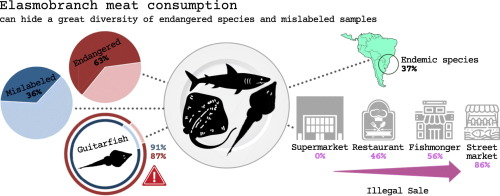
A recent study, conducted by researchers at the Federal University of Rio de Janeiro, shows that there is still a high incidence of endangered shark and ray species being illegally traded (63% in 221 analyzed samples). These frauds occur mainly in the ray group, especially the so-called guitarfish. However, no evidence of fraud was observed in samples collected in supermarkets.
Can eating dogfish be harmful to your health?
One of the motivations for consuming shark meat in Brazil is the absence of bones in its flesh. This characteristic is even valued when offering this fish to young children, as it minimizes the risk of choking. However, shark meat can pose a much greater health risk due to the presence of heavy metals.
Due to their long lifespan and position at the top of food webs, these animals accumulate certain compounds present throughout the chain, from single-celled organisms to the large fish that sharks prey on. The longer a shark's life and the closer to the coast it feeds, the higher the concentrations of substances dangerous to human health found in its meat.
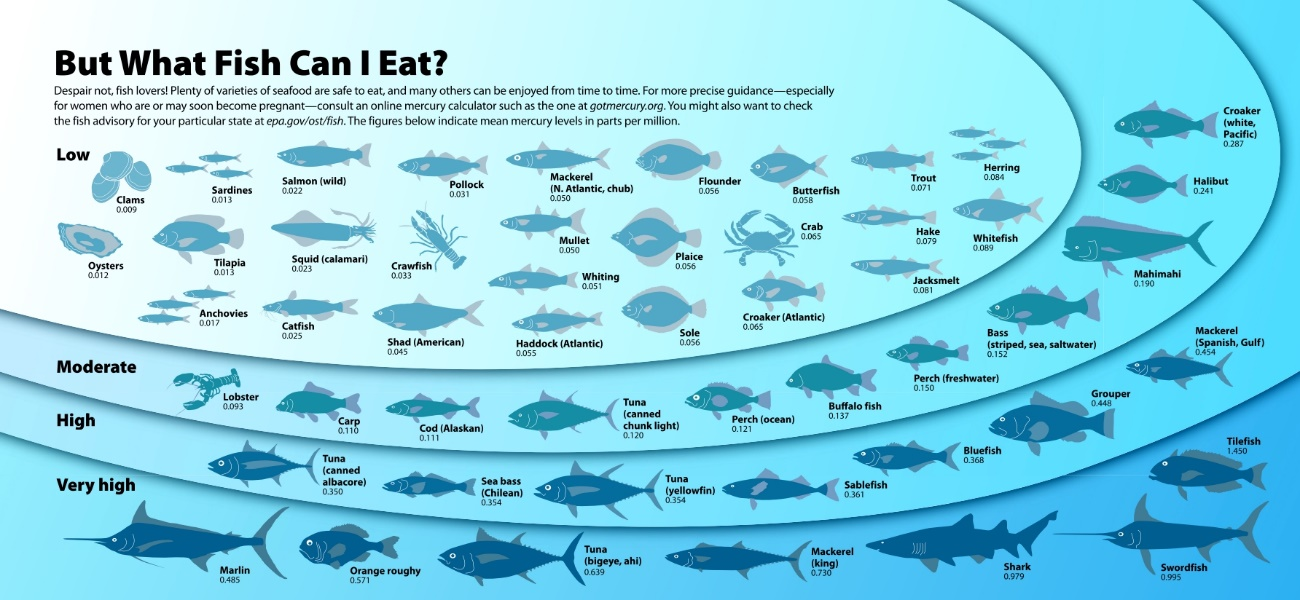
The U.S. Environmental Protection Agency and Food and Drug Administration (EPA and FDA) advise against consuming shark for women who are pregnant or planning to become pregnant, breastfeeding mothers, and children, due to the high concentrations of mercury found in analyses of this fish, as well as the consumption of other top predatory fish, such as swordfish and some tunas.
And finally....
Consuming shark meat itself is not a crime, but it could hardly be considered sustainable.